“The Cup Gives Cluj No Quiet Exit”
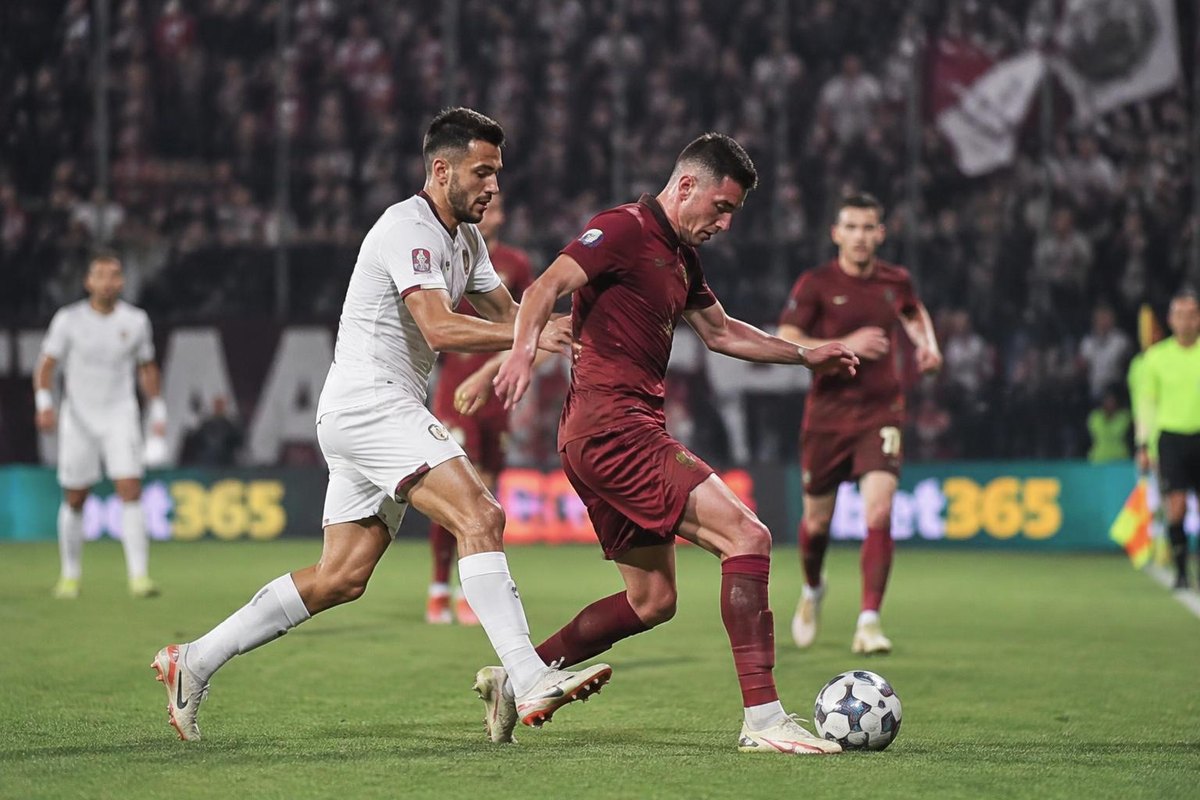
A 1-1 draw in Craiova leaves U Craiova 1948 CS and FC CFR 1907 Cluj level after a night that belonged first to the home side and then to its visitors.
At the station in Craiova, a man is selling covrigi from a blue plastic crate and keeping the paper bags tucked under his arm against the wind. He asks whether I have come for the cup. I say yes. “Then you have chosen the right night,” he says, though the match has not yet offered him any reason to be pleased with it.
I have come 1,461 kilometres south-east from Köln, where my previous stop was a full ground and a tram ride home. Craiova is a different scale of arrival: a city in the Oltenia plain, with the railway lines bringing you in without ceremony. The station’s broad, practical rooms are made for people going somewhere, not for visitors looking for a view. I walk towards the centre, eat a bean stew with bread at a small table, then take a taxi out to Universitatea Craiova Stadium. The driver has a radio on low. The voices are discussing the cup tie as if the result might depend on whether anyone speaks too loudly about it.
The ground is bright against the evening, its exterior more useful than ornamental. There are 39,436 people inside, a middling crowd for this venue, but the stands have the busy, close sound of a night with a point to prove. U Craiova 1948 CS and FC CFR 1907 Cluj know each other well enough to have stopped pretending that a meeting is merely another fixture. They are rivals in both clubs’ books, and across their last six meetings Craiova have won once, drawn four and lost once. The league meeting on 3 May went 2-0 to CFR. This is the Romanian Cup, not a chance to alter the league table. It has its own consequence, and the crowd knows it.
A side that keeps coming back
Craiova’s story here is not one of a club that has spent its life trying to climb to the top. It has remained in the Romanian First League through the 25 seasons in the archive, and its honours include the league title in 2050/51 and 2061/62, the Romanian Cup in 2062/63, and European trophies as well. Daniel Petre, now a name carried around the club as one of its enduring figures, was the leading scorer through much of its early sustained success. Sergiu Armăşelu, another of the club’s long servants, belongs to the same internal geography: a player remembered not just for the shirt but for the years in it.
They finish second in 2062/63 and are second again so far this season. CFR arrive with a different weight of domestic history. Even a club accustomed to collecting trophies can be made to wait by a cup tie.
Alexander Mair spent seven seasons at CFR before joining Craiova, and Corneliu Gheorghete also wore the Cluj colours for years. Romeo Matei, on the visitors’ side, once played for Craiova. These facts are not announced over the loudspeakers. They sit quietly among the crowd’s knowledge, like the local names on a timetable: familiar, but only useful if you know what they mean.
The first eleven minutes
Craiova start in a 4-4-2, a shape different from their usual arrangement. Andrew Cameron is on the left and Héctor on the right; Alexandru Albu, 17, begins up front. CFR also use a 4-4-2, with 16-year-old Romario Szilágyi at centre-back. These are young players in a match with no shortage of older history around it, but the ages are not the story once the ball is moving.
The first goal arrives in the 11th minute. Cameron, playing on the left, scores with a shot from close range, at mid height. The home support has been waiting for something definite to gather around, and now it has it. Craiova have taken the lead; a cup tie has a shape, if only for a while. The noise does not become a roar so much as a sustained insistence, the sound of people asking their side not to give the advantage back.
CFR have more of the ball, and their attempts keep the home end attentive. The goalkeeper is made to work; the visitors test him often enough that the crowd’s applause has a slightly relieved edge to it. A ball strikes the woodwork for each side, twice each over the evening, and the tie keeps resisting the neat conclusion that either set of supporters would prefer. He is named player of the match. He leaves in the 66th minute, by then having made the case for himself without needing to stay until the end.
Cluj’s answer
I spend the interval behind a row of men in dark jackets, one of whom carefully folds his empty paper cup into a square. He is watching the pitch rather than talking. When I ask if he thinks CFR will come back, he gives me a glance that says the question is not worth the cup. Then the second half begins, and the visitors begin to make their pressure count.
The substitutions give CFR new hands in a match that is becoming harder for them to leave as it is. In the 79th minute Barta scores with a shot along the ground. The equaliser is not an excuse for either end to relax. It is a change in the arithmetic, not a settlement. The visitors have drawn level, and suddenly the final minutes belong to the whole ground again: every small delay, every clearance, every attempt to make something happen carries the weight of a possible last word.
There is no late goal to separate them. The match ends 1-1, and the crowd comes out into the night in two broad streams, with the usual mixture of conversation and silence. I hear one man say that Craiova should have finished it; another answers that CFR have done enough to keep themselves in the tie. Neither sounds surprised by the argument. This rivalry has had draws before, and the latest one feels less like a compromise than a postponement of judgement.
The road back
The cup has given Craiova an evening in which the league champions’ habits do not decide everything. CFR remain a club with 35 Romanian First League titles. Those runs ended, as all runs do, in a season when another club took the prize. The current Romanian First League title is theirs again, but this tie has made plain that old authority does not travel untouched into a knockout match.
For Craiova, there is something apt in the way the night remains unfinished. The club has spent decades at the top level, gathering honours and building a history that is not simply a list of winners. At the railway station later, I buy another covrig and brush the crumbs from my coat. The man with the crate has gone. The cup tie has not gone anywhere either. Both clubs leave level, with the next part still to come.