“The Loire Keeps Its Own Pace”
A friendly in Tours offers a small ground, a larger river and a reminder that a club’s history is measured in more than its highest division.
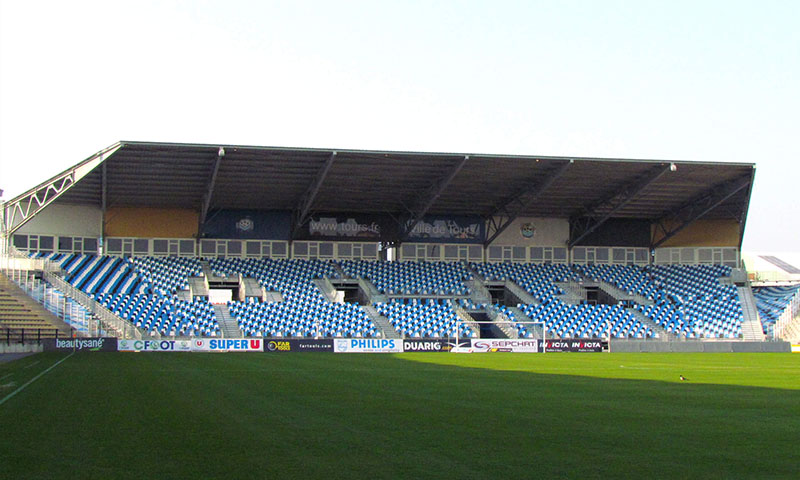
The Loire is broad enough at Tours to make the opposite bank feel like a separate appointment. On Sunday, 27 April 2064, I cross it with time to spare and a paper bag warm against my hand. The river is moving at its own pace. So, for much of the afternoon, is the town.
I have come 847 kilometres north-east from Madrid, where two days earlier I watched a derby at the Santiago Bernabéu. The change in scale is not a criticism of either place. Madrid gives you the sense that football can fill a city; Tours lets you hear the cups being put away in a café before you reach the ground. I take the train into Tours and walk towards the Stade de la Vallée du Cher, stopping for a slice of tarte aux pommes and a coffee at a counter where the owner keeps one eye on the clock. He asks whether I am going to the match. When I say yes, he nods as if that settles the matter and turns back to his till.
A friendly is an honest word. It does not promise a grand occasion, and the 396 people inside the ground do not pretend they have come to witness one. There is room to find a place without negotiating a row. The day is mild. I can hear a voice from several seats away without anyone needing to raise it.
A town and its club
Tours is a city shaped by the Loire and by the routes that meet around it. Its old centre is close enough to the modern streets that the past does not need to be announced with a brass plaque every few minutes. The river has always been the better guide: a line through the landscape, not a border that asks permission to cross. The ground’s name, Stade de la Vallée du Cher, points to the other river in the city, the Cher, and to a district beyond the most familiar postcard view of Tours.
Tours FC’s story has not been a steady climb towards a promised summit. In the seasons of its recent record, it appears in French National 2, sometimes in group C and once in group B. The club’s best-known players include Karim Ibrahim, whose 306 games across 13 seasons make him a figure held in the club’s memory, and Jean-Pierre Ntazinda, who has scored 29 league goals for Tours. Those numbers do not turn this friendly into a referendum on the past. They give the badge a human scale: people who have stayed, played and been remembered.
Paris Saint-Germain 2 arrive with the weight of a different institution’s name, but this is the reserve side, and the afternoon belongs to the two teams on this pitch, not to a contest of reputations. Their own history in the archive reaches through 38 seasons, with French National 2 - C titles in 2029/30, 2030/31, 2052/53, 2057/58, 2060/61 and 2061/62, and French National 2 - A titles in 2003 and 2050/51. The distinction matters. A reserve team can carry a celebrated name while still having to earn its afternoon in front of a modest crowd.
A friendly, played properly
Paris Saint-Germain 2 take the lead in the 17th minute through Marin Chabot, and Chabot scores again in the 43rd, from the penalty spot. Tours have their own penalty, converted by Jean-Pierre Ntazinda in the 73rd minute. That makes the final score 2-1 to the visitors. Valentin Mauquit is named player of the match. It is a compact account of a game in which the visitors have more of the ball and Tours make the occasion competitive; I do not need to dress it up as a cup tie.
The first half has the looseness that can come with a friendly, but not indifference. People around me track the score closely, and the second goal draws the kind of brief silence in which a paper cup being crushed sounds almost discourteous. When Tours pull one back, the sound is not huge. It is definite. The crowd has not come in numbers to manufacture an atmosphere, and nobody tries. A clap travels along a row, stops, starts again. That is enough.
Ntazinda’s goal changes the temperature of the last stretch. The home supporters lean forward; the visitors’ small group behind the far side keeps its attention on the pitch. A friendly may leave no table altered and no trophy in a cabinet, but the players still have to finish the work in front of them. At the end, there is no grand ceremony. The crowd begins to thin, and the people nearest the exits talk about the match as they walk.
The useful scale
Sometimes a match is simply a match, and the useful part of the day is the way it fits into its place. Here, the walk back towards the Loire gives the afternoon room to settle. A cyclist passes with a loaf strapped to the back of his bicycle. At a bakery window, the last few pastries sit in a neat row under the glass. The city is not waiting for me to draw a conclusion about it.
I think of the earlier stops on this stretch: Argentina, Wales, Austria, Denmark, then Madrid. Each has its own answer to the question of what a football day is for. It gives me a river crossing, a warm slice of tart and a ground where fewer than four hundred people see a game that remains close enough to matter to them.
Ileana, at home in Cluj, thinks I am a little mad to travel so far for football. She is not wrong about the distance. But the point is not that every match must become an epic. Most days go as planned: the train arrives, the coffee is hot, the ticket works, and the game ends with enough time to walk back through town. On this Sunday, the Loire keeps moving beside me, indifferent to the score and perfectly suited to the trip.