See Newport’s Win Through the Steward Who Stayed at His Post
The morning after Newport County beat Doncaster Rovers, one man’s account of trouble outside Rodney Parade puts a 2-1 result in its proper frame.
Newport County beat Doncaster Rovers 2-1 on Tuesday, 8 April, and the next morning I leave Newport with the score already settled and one man’s account of the trouble still with me. He is a steward at Rodney Parade. The previous day, outside the ground, fighting draws riot police into the street; flares and a charge follow in the stands. He watches from the edge of it. The match starts on time and carries on. By the time I am leaving, those facts sit together without cancelling one another out.
The morning after
I meet the steward as the town is waking into its ordinary business again. There is no grand postscript to the previous day in his manner. He speaks plainly, as someone describing a duty that did not stop being a duty when the crowd turned difficult. “You keep your eyes on what is in front of you,” he tells me. It is a small sentence, and a better guide to the day than any attempt to make the trouble sound like theatre.
I have travelled 10,994 kilometres north-east from River Stadium in Argentina for this stop. The scale of that distance belongs to the column’s itinerary, not to Newport’s streets: here, the morning is local and workmanlike. Newport sits on the Usk, close to the Severn estuary, a Welsh city with a long relationship to industry and the river. The docks and industrial work shaped its life. I do not need to turn the town into a backdrop for yesterday’s disorder. People are going about their morning, and the steward has a shift and a match to remember.
He does not offer a heroic version of himself. He was near the trouble, not at its centre, and does not claim to have seen everything. That distinction matters. Outside, ultras fight and riot police are on the street. Inside, flares rise and a charge moves through the stands. He describes the edge of the scene: where a steward tries to keep a view of what is happening, and where the job is to stay alert rather than to join the noise. I ask what it is like to return to the ground after that. He gives me no speech about courage. “You come back and do the work,” he says.
A club in the town
The County have been part of the city’s sporting life for generations, with the familiar business of a club’s fortunes bound up in the place around it. In Newport, a club’s past is not only a parade of good days; it includes the effort of keeping a name alive when the old structure fails.
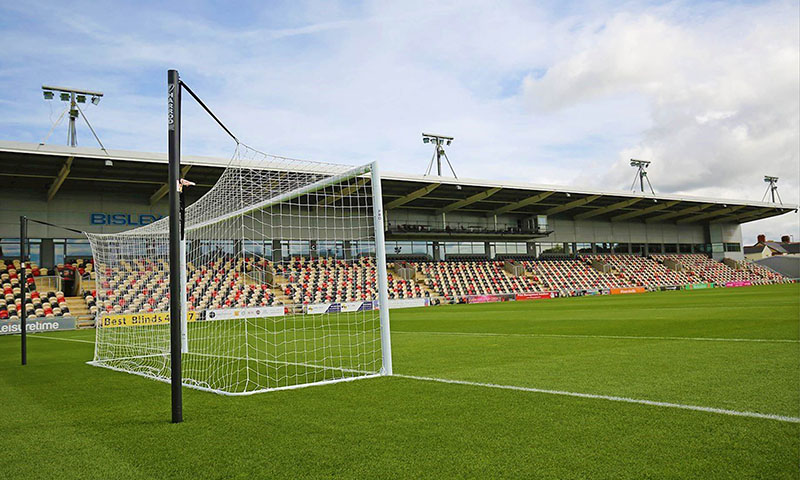
Rodney Parade is a ground shared with rugby, and its scale is a useful counterweight to the vast distance I have just crossed. There are 1,723 people in the ground for this Vanarama National League match. It is a small attendance, not a small occasion to the people working it. A steward has a view of the crowd that is different from mine: not the sweep of the stand, but the points where people gather, the gaps that need watching, the moment a routine afternoon begins to change.
Newport won the Vanarama National League in 2034/35 and 2036/37, then the National League South in 2009/10; in the later seasons that matter to this day they have moved between the fourth and fifth tiers. They were relegated from League Two in 2054/55, went back up in 2057/58 and came down again the following season. On Tuesday they are sixth so far, with Tom Evans in charge since 2058. That history gives the match its modest pressure: a club familiar with the work of trying to climb again, playing a fellow former League Two side in the same division.
Doncaster, seventh so far, have their own long reach through the leagues, including a League One title and four League Two titles. Across the last six meetings, Newport have won three, drawn one and lost two. Doncaster won the most recent meeting before Tuesday, 3-2, in November. None of that tells the steward what to do when a flare appears. It does explain why a National League match is not merely an interval between more celebrated fixtures. Both clubs have histories that make the fifth tier a place to compete from, not a place without consequence.
The ninety minutes
The match begins on time. Newport score after one minute, Chris Farrar putting a low shot with his foot near a post. Five minutes later Matthew Jefferies makes it 2-0, a close-range shot with his foot driven high through the middle, just under the bar. The crowd has barely settled into the afternoon before the scoreboard has given it a shape.
The trouble outside and in the stands does not stop play. From where I watch, the football is an ordinary contest in the best sense: the score brings early certainty, then the game asks Newport to keep it. Doncaster’s Christian Carter heads in from close range in the 69th minute, making the last part of the afternoon less comfortable. Newport hold on for the 2-1 win. That is the match, and the result stands without needing a grander description.
It would be easy to make the goals the whole story because they provide a clean sequence: Farrar, Jefferies, Carter. But the steward’s day is not measured by the score alone. He is not watching the match as I am, with the freedom to follow every phase. His attention is divided by the work around him. The result belongs to Newport; the memory of the day belongs in part to the people who must stay attentive when the match is no longer the only thing happening.
I write a postcard to Ileana in Cluj before leaving. I tell her Newport won 2-1, that the steward spoke calmly about a day that gave him reason not to, and that I am thinking of how little a ground’s size says about the care required to run it. I leave the rest unwritten. A postcard has room for a few lines, and the day resists being made tidy.
The work remains
Newport’s season is still in progress. Sixth place is where they stand so far; the win over Doncaster does not settle what comes next. For the steward, though, the morning after has its own conclusion. The crowd has gone, the result is fixed, and the job is to return to the ordinary habits by which a ground opens itself to people again.
This man does not claim Newport as a symbol, or the trouble as an episode that can be folded neatly into a football story. He tells me what he saw from where he stood. In a town shaped by work and a club that has had to begin again, that is enough: one person at the edge of a difficult afternoon, doing his job while the match goes on.