The Long Way to Altach, the Long Way to a Draw
A journey east from Newport ends in the Vorarlberg, where Sportclub Rheindorf Altach and Linzer Athletik-Sport-Klub share six goals and a point apiece.
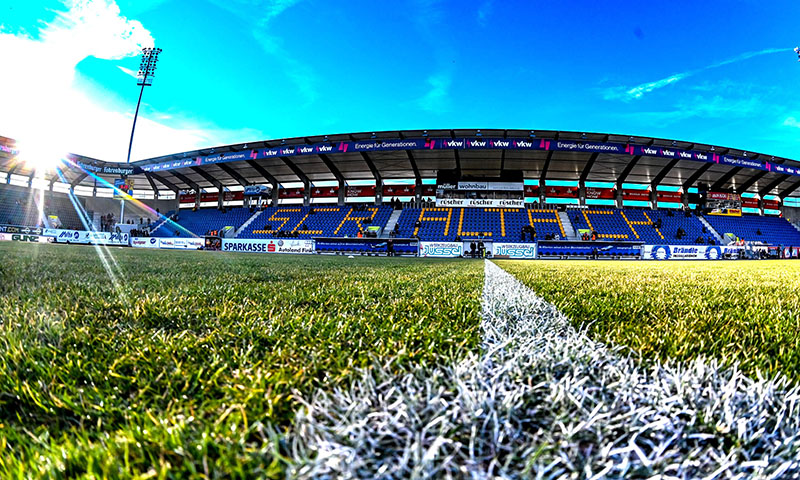
The whistle goes at Stadion Schnabelholz on Monday, 14 April, with Sportclub Rheindorf Altach and Linzer Athletik-Sport-Klub level at 3-3. There are 6,897 of us in the ground, and the match has travelled through every sort of complication a football afternoon can make for itself: Altach score three times, LASK answer three times, and the last goal arrives in the 90th minute. I am at the end of a long way east. The game is where it ends; the day has been made by the miles that brought me here.
From Newport, the distance is 1,025 kilometres east. On a map that sounds clean. In a carriage it is a succession of directions, platforms and changing views, the sort of day in which a country is not something you enter so much as something that gradually takes over the window. I leave Wales behind and continue through the continent towards Austria. The route is a chain rather than a straight line. Stations interrupt it; the names outside change before the landscape does.
West to east
I have come from Rodney Parade, where Newport County played on 8 April. The intervening stops have taken me from France to Tunisia, across Paraguay and Uruguay, through Argentina and back to Wales. This is the next leg, and the longest is not a story of misadventure. Nothing goes wrong. There is no missed connection to rescue the day from its own quietness, no locked door or sudden diversion. I have the seat, the window and the work of getting east.
The carriage is a good place to notice how little of travel belongs to the traveller. Other people get on with their errands, their books, their conversations, while I watch the land go by and keep my bags close. There is no football crowd yet, only the ordinary occupation of a train: people settling into a seat, looking up when the doors open, and returning to whatever they were doing. I am the one who has given the day a destination. To everyone else it is simply a Monday.
The route from Newport towards Vorarlberg has a useful lesson for anyone who likes to imagine a journey as a line. The map gives me a direction; the railway gives me a series of decisions already made by geography and timetables. I travel east through changing landscapes and stations, towards Austria’s far west. The country beyond the glass changes by degrees: built-up stretches, fields, platforms with their own brisk order, and finally the closer folds around the destination.
The mountain country is not a backdrop that can be claimed for the whole journey; it gathers around the destination. The Rhine valley gives the region its open route north and south, while the mountains close the view beyond it. After so many hours of being carried through places, arrival is not a grand entrance. It is the small satisfaction of recognising that the direction has at last become a town.
The ground is on the edge of that modest scale. Stadion Schnabelholz is a small ground, though 6,897 people make it sound much larger from inside. There is no need to pretend that Altach is a metropolis or that the stadium is a monument. Its interest is precisely that it belongs to a community whose football has climbed a long way without losing the proportions of its home.
A club in its place
The club has spent seasons in the Austrian Premier Division across several stretches, and its Austrian First Division titles came in 2005/06, 2013/14, 2028/29 and 2031/32. In recent seasons it has made itself a regular presence in the top division: fourth in 2061/62 and 2062/63, and fourth again so far this season. The standings do not tell the whole character of a club, but they show a team that has held its place rather than merely visited it.
There is a local logic to football here. Altach’s rivals include clubs from nearby Lustenau, Bregenz and Dornbirn, names that make the map feel more intimate than the long journey in from Wales. Linzer Athletik-Sport-Klub are second in the Austrian Premier Division so far this season, after a run of high finishes that includes titles in 2059/60 and 2061/62. In the last six meetings, Altach have won once, LASK twice and three games have been drawn. Another draw is not a novelty, but this one has rather more movement in it.
He spent the seasons from 2053/54 to 2063/64 at LASK, making 347 appearances and scoring 86 goals there, before appearing for Altach against his former club. He scores for the home side on Monday, and later moves from the left to a central position during the game. A former player does not need a speech to make the past present. The opponent’s colours do that work for him.
The game keeps turning
Altach’s first goal comes in the 17th minute, unattributed: a drive struck low and hard from inside the box, travelling along the ground. Six minutes later Miroslav Marinov puts the ball into his own net for Altach. Feiner’s penalty makes it three home goals by the 36th minute. It is a hard opening for LASK, but the visitors do not spend the rest of the afternoon admiring it.
Vicente scores in the 39th minute, a drive from close range, at mid-height through the middle. Jeffrey Bartmann follows four minutes later, his drive low and near a post. Before the interval, the match has become a one-goal contest again. From the stand, the figures on the scoreboard matter less than the way the game keeps refusing to settle. I have come a long way for a league match; the players make it feel as if the distance has been spent wisely.
The second half brings no further Altach goal. LASK make changes, and Theofanis Vouzas comes on in the 72nd minute. In the 90th, he scores with a header from close range, low and near a post. The level score at the final whistle is not a rescued victory or a lost one. It is a point each, earned in a match that has twice asked one side to begin again.
The visitors’ late equaliser makes the railway journey feel almost too neat as a frame: one destination reached after a string of changes, one score settled only at the far end. But football is not obliged to echo the route that brought a spectator to it. Altach have scored three times; LASK have come back; the match ends even. That is all, and it is enough.
At the end of the day
When the noise thins, the ground returns to its scale. The crowd has filled it with a presence that a photograph of the place empty could not explain. I leave with the sort of match that stays in the mind not because it settled a grand argument, but because it would not let the afternoon go slack. A 3-3 draw is a simple line in a table of results. Seen from the stand, it has the shape of a journey: progress, interruption, another attempt, and a final arrival that is not quite where either side expected.
Altach remain fourth in the division so far; LASK remain second. Monday changes neither club’s wider story into something final. The home side are still the careful builders of a place in the top flight, while the visitors carry the habits of a club accustomed to challenging near the summit. On this ground, that difference is background, not verdict. The game belongs to the people who watched it and to the two sides who made it.
My own day has no comparable climax. I have gone east, watched the view outside the glass change, and reached a small ground in the Rhine valley. Ileana, at home in Cluj, would say that is a great deal of effort to sit through a draw. She would be right about the effort and wrong about the draw. The whistle leaves us level, but it does not make the miles feel wasted. The journey has done what I asked of it: carried me to the end of a line and given me a match there.