**Madrid’s Away End Made the Derby Feel Like Two Cities**
I spend the evening before the derby among Athletico Madrid’s travelling support, then follow their colours into a Bernabéu that gives neither side the last word.
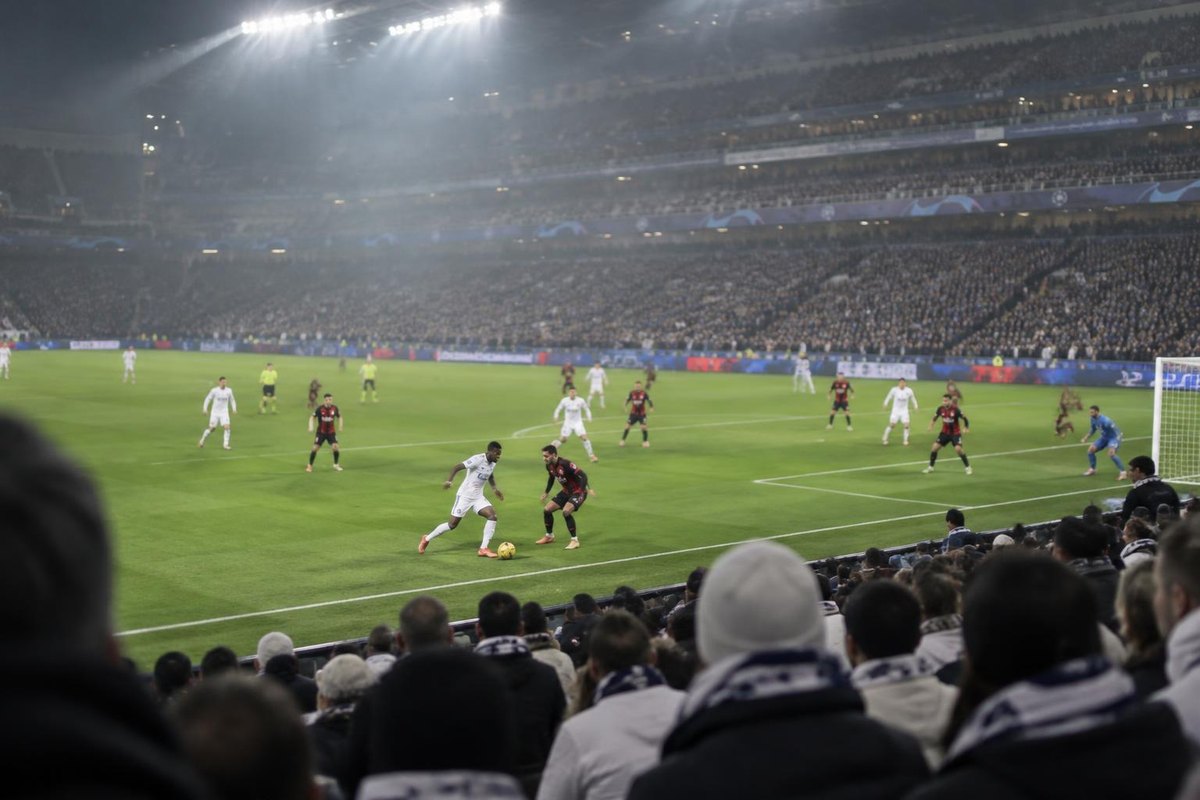
Madrid, Friday evening
On Friday, 24 April, I arrive in Madrid the evening before the derby, 1,911 kilometres south-west of my last stop at Arena Herning in Denmark. A journey that crosses that much of Europe should leave a man with a clean shirt and a clear plan. I have neither. Rain finds its way through my only coat, and I spend the first part of the evening trying to look as if this is deliberate.
I find shelter, a place to sleep and something to eat. The meal does its quiet work; the coat does not. I meet Athletico supporters in the city and tell them I am going in with their end. They accept this without ceremony. A derby is not a subject that needs much introduction, though it does require one to know whose colours one is wearing and when to keep one’s mouth shut.
Madrid is not merely the space between the station and the ground. The city draws people and work towards its centre; its streets carry a capital’s traffic even on a night when the football gives the conversation a single destination. The Santiago Bernabéu stands in the north of the city, amid broad roads and buildings that make the approach feel urban rather than ceremonial. From a distance the ground announces itself. Up close, the scale is more practical: turnstiles, queues, people looking for the right entrance and stewards trying to keep the streams moving.
The ticket stub goes into the same pocket as my other small proofs of travel. At home in Cluj, Ileana thinks the shoebox in which I keep them is evidence of a minor illness. She may be right. This one is the paper of a derby at the Bernabéu, with the price printed on it; I do not need the price to tell me what the ticket bought. It bought a place among the visitors, not a view of the city from the comfortable side of the argument.
The red in the city
On Friday, 25 April, the visiting colours are visible well before the ground. Athletico’s people gather in knots, then move towards the stadium together. Their songs are carried along the pavement, sometimes neat, sometimes broken by traffic and the ordinary business of getting a large crowd through a city. There is no need to pretend that the whole town has stopped for them. Madrid is still Madrid around the noise: people going about their day, glancing over, making room where the crowd narrows the pavement.
I go with the supporters rather than seeking a solitary route to my seat. It is the only way to understand an away end: not as a block of colour seen from above, but as a trip people make together, with the same turn of the head when a steward points them on and the same impatience when a queue pauses. A home crowd owns the familiar streets. The visitors borrow them for the afternoon and give them back when the match is over.
The Bernabéu is a ground whose history is bound up with Real Madrid’s long ambition. Its name recalls Santiago Bernabéu, the player and president who helped make the club’s scale part of its identity. Real’s European history includes five consecutive Cups from 1955/56 to 1959/60 and three successive Champions Leagues from 2015/16 to 2017/18. Its most recent Spanish First Division title in this account came in 2057/58. The old achievements do not make the present easy: Real are fifth in the league this season, and the derby arrives after a recent stretch that has made their position a subject of argument.
Athletico bring their own history into the stand. They have won the Spanish First Division 25 times, most recently in 2062/63, and are top again this season. Their current run is one title in a row. They also won the Champions League in 2062/63. None of that makes them guests who have come to admire the home side’s architecture. Their supporters sing as people who expect their club to belong in this contest, and the team has reason to think so. In the previous six meetings, Real have not won one: three draws and three defeats. The last meeting, in November, ended 1-0 to Athletico.
In the visiting end
The noise changes once we are inside. It has a roof to catch it and a broad bowl to return it, though the voices do not become one simple roar. The home support answers from elsewhere in the ground; the visitors keep their own rhythm. The crowd is 81,044, a full house. From among Athletico’s people, the number is less important than the faces turned towards the pitch and the way a song resumes after a pause.
The game begins with the balance a derby can have when neither side is prepared to let the other settle the terms. Real’s Pele gives the home crowd something to lift at 37 minutes, striking a shot with his foot from outside the box, high and near a post. The away end has scarcely had time to take that in when Farid equalises three minutes later, heading in from close range at mid-height. The visitors’ reply is immediate enough to make the noise around us change its purpose.
At 48 minutes, Paulo Henrique puts Athletico ahead with a header from close range, low. The people around me rise and fold into one another; the sound does not need translation. Now it is Real who must find a response, and the home crowd supplies its demand. Ronaldinho brings the sides level at 71 minutes with a shot with his foot from close range, along the ground and near a post. The match ends 2-2.
There are no further goals to settle a rivalry that has lately refused to give Real an easy answer. A point is not a verdict on a season, and this is a league match, not a final. But in a derby the small measures count: who has made the other side chase, who has had to answer, whose songs have lasted.
The paper in the box
The walk out is not a procession of victors. Both ends carry away a score that can be argued over, and both clubs have reasons to see more in it than a line on the table. Athletico arrive as champions from last season and leaders now, but a draw here is not the same thing as a claim completed. The season remains open.
I keep to the visiting crowd as it spills back into Madrid. The rain from the previous evening has left its mark on my coat, and I am not improved by wearing it. There is an absurd dignity in carrying a damp garment through a city that has already provided a full evening’s entertainment without needing me to contribute. I have the ticket stub, though, and that is enough. It will go into the shoebox in Cluj beside the tickets from Paraguay, Uruguay, Argentina, Wales, Austria and Denmark. Each paper looks much the same once the trip is over. This one will remind me of the night before, the wet coat and the red voices travelling into the Bernabéu, then of a derby that refused to belong entirely to either side.