What Does Tunis Give You Before Kick-off?
Five days ago, a day among Tunis’s old streets and market stalls ends beneath the lights with Espérance Sportive de Tunis beating Asante Kotoko SC 3-1.
06:40
Tunis is already bright when I begin the day, five days before this column reaches print. I am here for the African Champions League, but the match can wait. The ground lies south-east of the centre, in Radès, and the city offers more than enough to occupy the hours between breakfast and kick-off. My phone, unhelpfully, has a different plan: I leave it behind at the place I am staying.
I discover this after setting off. There is no grand drama in it, only the familiar private irritation of patting pockets that are empty. I turn back. The delay costs me part of the morning, and my own company is less entertaining without a screen to consult. Ileana, in Cluj, would call this typical. She would be right, and I am glad she is not here to say so.
Tunis is a city where the old and the working day share the same pavement. The medina is not a museum arranged for the visitor: doors open on shops, people carry their errands through lanes made before anyone thought to make them wide. A little patience is required, and sometimes the good sense to stop trying to walk in a straight line. I put my phone away again, this time deliberately, and follow the street as it turns.
11:15
The medina gives the morning its proper scale. A carved doorway holds the eye; then someone passes with a sack and the doorway is simply part of the day again. The souks are busy with the small exchanges that make a market more than a picture: a question, a reply, a purchase wrapped and carried off. The air smells of food and dust warmed by the sun. I take a moment at the Zitouna Mosque, whose presence makes the old quarter feel less like a collection of lanes than a city with a centre of its own.
Tunis has been shaped by successive powers and migrations, and its old streets do not flatten that history into a single story. Nor does the city stand still for the benefit of a traveller. In the newer avenues, traffic takes the spaces the medina refuses to give it. The contrast is not a lesson so much as a fact of getting around: one part of Tunis insists on walking; another makes the crossing the day’s main negotiation.
At lunch I find something to eat without turning the meal into a quest. Tunisian food has its own confident heat, and the harissa is not decoration. I take it cautiously. The table beside me is occupied by people who appear to have no need to discuss the coming game in order to know it is coming. Football does not have to announce itself at every meal. Sometimes it is enough that the afternoon has somewhere to go.
There is time for the Bardo Museum, whose collections make a different argument about Tunisia’s long place on the Mediterranean: mosaics and objects from the ancient world, kept in a building that has had a life of its own. I cannot take in everything in a single visit. A traveller who claims otherwise is either in a hurry or pretending. I leave with a few images in mind and enough daylight to get south towards the ground.
16:30
The journey out to Radès takes me away from the compact old quarter and towards the wider city. The ground’s position, south-east of central Tunis, makes the match part of the metropolitan day rather than an excursion to a distant town. Around the approach, the football crowd becomes easier to recognise: shirts, scarves, groups moving with a purpose that has been missing from my own wandering all afternoon.
The club won three in a row from 2040/41 to 2042/43, four from 2048/49 to 2051/52, and six from 2053/54 to 2058/59. Its latest run, three successive titles from 2060/61 to 2062/63, is still going. This is not a club arriving at the competition to see what it might become. It comes carrying a history that makes every home night feel like a defence of something, even when the result is not in doubt.
Asante Kotoko SC bring their own weight, rooted in Ghana and remembered in this competition for titles in 1970 and 1983. The sides had met six times before this match; Espérance had won five and drawn one. Their most recent meeting, on 23 February, ended 2-0 to the Tunisian club. That is a useful measure of the task for the visitors, but not a script. At the ground, the past can settle into the stands; it cannot play the next ninety minutes for anyone.
19:45
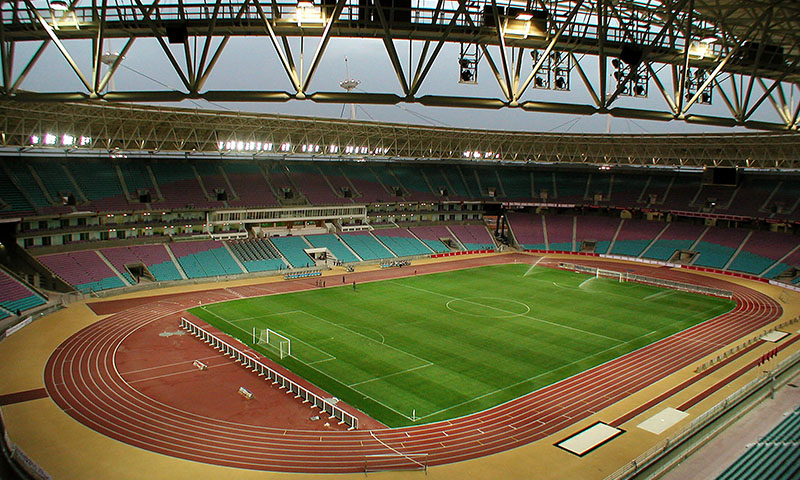
The Stade Olympique is full: 50,297 people inside. There is no empty space to soften the sound. Red and yellow occupy the eye, and the noise gathers quickly into something continuous, punctuated by the sudden lift that follows a goal. Espérance score in the eighth minute, then again in the 12th. The start is abrupt enough to turn the evening into a test of composure for Kotoko and a test of expectation for the home crowd. A lead of two is a gift; it is also an invitation to demand more.
The third arrives in the 36th minute. I cannot tell you what kind of finish it is; what matters from my place is the movement of the crowd around it, a mass rising and settling with the ease of a tide. Espérance have put three between themselves and their visitors before half-time. The margin reflects a home side in command, but a match is not made of figures alone. Kotoko keep competing, and the stand does not feel free to leave the evening to the arithmetic.
They find a goal in the 82nd minute. The response from the travelling support is sharp and deserved; the home crowd has to take the reminder that a comfortable night is not the same thing as a silent one. Espérance win 3-1. Their advantage in these meetings grows, and their run of African Champions League titles remains intact. The result belongs to this competition, not to a domestic table. For Kotoko, the late goal gives the journey home a different sound from the one the first half threatened.
When I leave the ground, the city I walked through in the morning has become the city that receives a football crowd at night. I have my phone again, my bearings less securely, and a day that has refused to run in a line. Tunis is not merely a pause before the match. The match is the final room of the day, reached after the market, the mosque and the museum; at the end, the crowd sends me back into the evening with the sound of the last goal still close behind.