They painted the stands and the moon came up
A letter from Guatemala City, where a continental night shared the town with a festival and the old ground felt full again.
Dear editor,
I am writing this from a small table in the Hotel Pan American, where the wedding party downstairs has been singing for an hour and shows no sign of stopping. The tin roof of the terrace is loud with rain, and every few minutes the band strikes up another cumbia and the guests shout along. I did not plan to be here. I planned to be asleep by now, with the notebook closed and the day done. But the night has other ideas, and you did ask me to write.
Today was the day of the game, the third of my six stops in this long swing through the Americas. The first thing you should know is that the city was not thinking about football. It was thinking about its patron saint, or its buses, or its rain. The feast of San Francisco de Asís had closed half the streets around the cathedral, and a procession of purple and white banners went by the hotel at noon, with a brass band and a float of the saint carried on the shoulders of a dozen men. I walked behind it for a while, because it was going my way, and because the rain had stopped and the smell of copal and street corn was everywhere. A woman beside me was selling little bags of toasted pumpkin seeds, and I bought one and ate them as I walked, spitting the husks into the gutter like everyone else.
**The ground behind the trefoil**
The gates were painted red and white, the colours of Municipal, and the walls were hung with banners that had faded in the sun. I got there early, because I always do, and because the procession had slowed me down and I wanted to see the ground before the crowd came. The man at the gate was eating a mango and did not ask for my ticket until I held it out. "It is a good night," he said, and I said that it was.
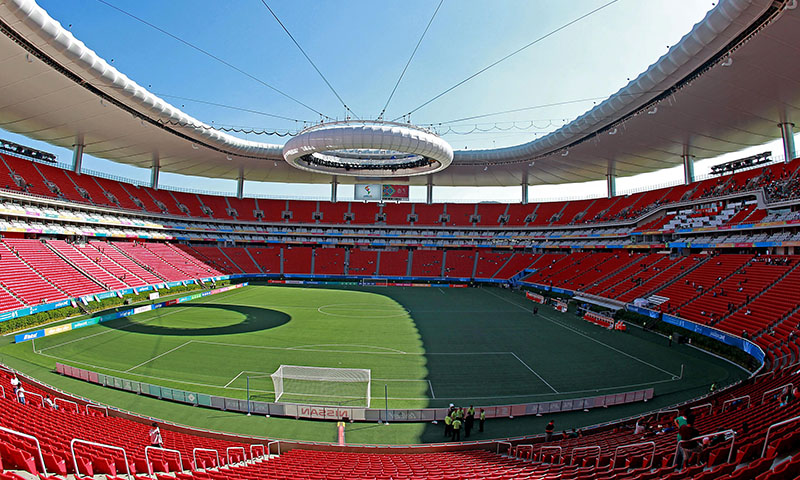
Inside, the stands are concrete and corrugated iron, with a roof only over the main side. The pitch is ringed by a low wall and an old-fashioned fence, and behind the south goal there is a bank of seats that looks as if it was bolted on in a hurry. The north end is open to the sky, and beyond it you can see the lights of the city and the dark shape of the volcano. I walked around the whole ground before the teams came out, and in the far corner I found a small shrine to the club's founders, with a candle burning and a plastic flower in a jam jar. "Every game," the old man beside me said, "we light it. For the ones who started it." He was wearing a faded shirt with a number on the back that I could not read, and he had a radio in one hand, tuned to a station that was playing cumbia and talking about the game. He told me his name was Don Chepe, and that he had been coming to El Trébol since the days of the old wooden stand. "They tore it down in the sixties," he said. "But the clover is still here."
**The visitors from Guadalajara**
The teams came out to a great roar, and the band in the corner struck up something that was half anthem and half dance tune. Municipal were in their red and blue stripes, and the visitors from Guadalajara were in white with a single red sash.
The game itself was a good one, though the score says more than the play. Guadalajara had most of the ball, as you would expect, and they made it count early when Rodrigo Alarcón turned in a cross after twenty-four minutes. The ground went quiet for a moment, and then the Municipal supporters began to sing again, louder than before. They were rewarded just after half-time, when a scramble in the box ended with the ball in the net and the linesman's flag down. For a while it looked as if the home side might hold on for a point, but Guadalajara kept coming, and in the seventy-fourth minute Fernando Navarro, who had come on only four minutes earlier, scored with a low shot that went in off the post. The away support roared, and the rest of the ground let out a long sigh, and then the singing started again, because that is what you do.
I am sorry I cannot tell you more about the football. But you know how it is: some nights the game is only part of the day, and the day is only part of the trip, and the trip is only part of a longer road. The score was one to two, and the clover is still there, and the moon came up over the volcano as I walked back to the hotel. I will write again from the next stop.
Yours,
Teodor