A capital day out, and the old stadium roars again
The Olympiastadion is a long way from the last stop in Norway, but Hertha Berlin's 2-0 win over Wolfsburg makes the 1,192km journey south feel like a homecoming.
The train from Molde to Berlin is not a single journey but a patchwork of connections stitched across the north of Europe. I left Molde on the morning of the 5th, a ferry across the fjord to Vestnes, then the Rauma line to Dombås, a slow crawl through the mountains to Oslo, and the night train to Hamburg. From Hamburg, the ICE runs every hour to Berlin Hauptbahnhof, and by the afternoon of the 7th I am stepping out into the cold, grey light of the German capital.
It has cost me, all told, about €180, and the trip has taken the better part of two days, but there is a rhythm to long train journeys that I have come to love: the changing landscape, the quiet conversations in the dining car, the slow approach to a city that has been the centre of so much European history. Berlin in February is not a pretty city. The trees are bare, the wind off the Spree cuts through a coat, and the sky is the colour of old concrete. But it has a weight that few places can match, and for a football man, the Olympiastadion is one of the great pilgrimage sites.
**The Old Lady**
Hertha Berlin are one of those clubs that carry their history in their name. The club's origins lie in the late 19th century, when a group of young men in the western part of the city founded a football club that would become one of the capital's most enduring institutions. The blue and white stripes have been the club's colours for as long as anyone can remember, and the nickname 'Die Alte Dame' - the Old Lady - has stuck for more than a century. The club has played at the Olympiastadion for decades, a ground that has seen Olympic summers and winter afternoons, and that still has the sweep and the scale of a stadium built to impress.
Hertha's history is a story of near-misses and occasional glory. They won German championships in the 1930s, but for most of the post-war period they were a second-tier club, bouncing between the regional leagues and the Bundesliga. The turn of the century brought financial troubles and a series of relegations, but the club has always retained a loyal following in the west of the city. The last twenty years have been a different story. Since the mid-2040s, Hertha have become a genuine force in German football: nine Bundesliga titles since 2050, four German Supercups, and two DFB-Pokals. The current manager, Furkan Çiçek, took over in July 2063, and the club sits fifth in the table as the season enters its final third.
**The long way round**
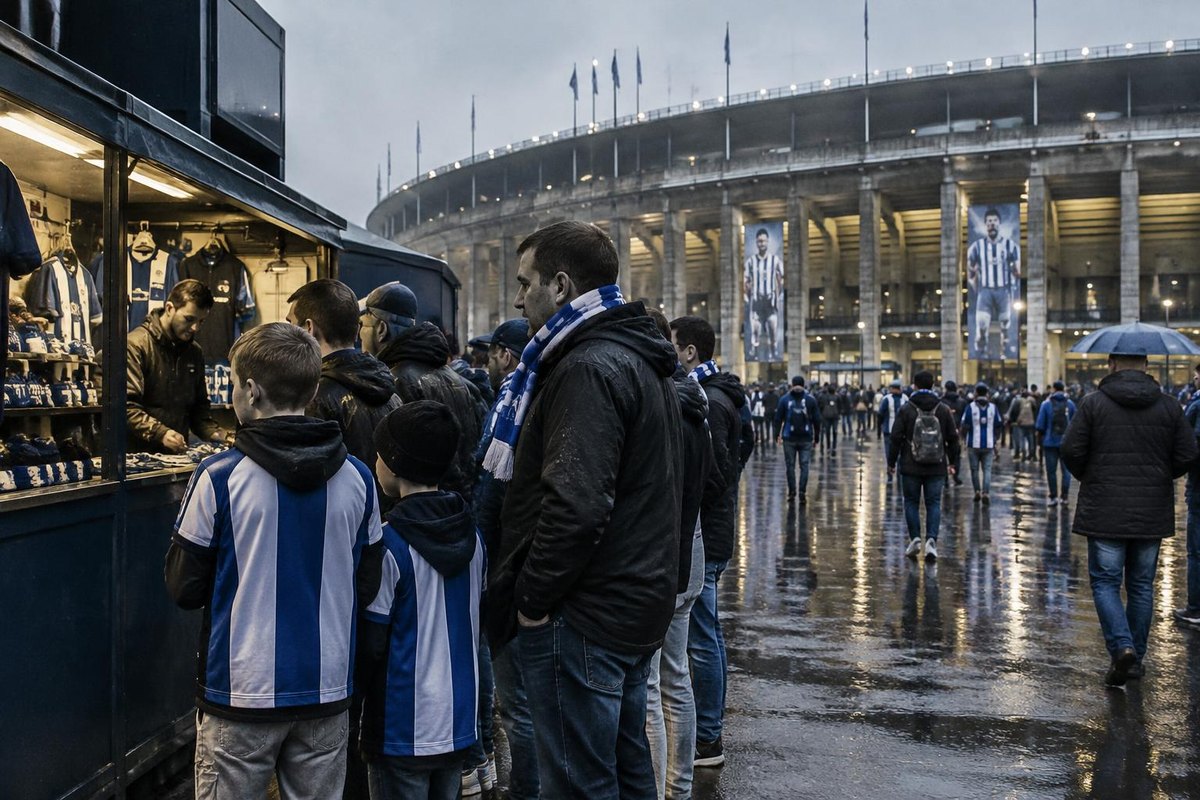
From the Hauptbahnhof, it is a short S-Bahn ride to the Olympiastadion station, and the walk to the ground takes you through the park that surrounds the stadium, past the old bell tower and the memorial hall. The stadium looms up suddenly, a vast oval of concrete and steel, and even on a cold Friday night it is an impressive sight. The floodlights are already on, cutting through the drizzle, and the crowd is beginning to gather.
I stop for a currywurst at a stand outside the ground - a Berlin institution, served with a roll and a generous squirt of ketchup. It costs €4.50, and it is exactly what I need after the long journey. The fans around me are a mix of old and young, many of them wearing the blue and white scarves of Hertha, and the mood is cautiously optimistic. Hertha have won four of their last six league games, and Wolfsburg, for all their recent form, are not the force they were a few years ago.
**The view from the Ostkurve**
My ticket is for the Ostkurve, the traditional home of the Hertha ultras, and it costs €35. The stand is steep and noisy, and the view across the pitch to the opposite side is superb. The stadium is a two-tier bowl, with the lower tier ringing the pitch and the upper tier rising behind, and it is filled to capacity tonight: 57,125 people, a full house for a Friday night game. The roof covers the stands but not the pitch, and the rain is falling steadily as the teams come out.
Hertha line up in a 5-2-1-2 formation, with Cris in goal, a back three of Sapozhnikov, Pueyo, and Estévez, and Heyik and Wimmer as wing-backs. Budschedl and Cvetković sit in front of the defence, McCann plays behind the strike pair of Robson and Reyes. Wolfsburg start in a 4-3-3, with Kuring in goal, a back four of Funes, Brun, Marc, and Lourival, a midfield of Xumetra, Radović, and Donati, and a front three of José María, Giddens, and López.
**The game**
Hertha take the lead after 14 minutes. A long ball from the back is flicked on by Robson, and Fernando Reyes is onto it in a flash, driving past Brun and firing low past Kuring. The stadium erupts, and the noise from the Ostkurve is deafening. It is Reyes' tenth goal of the season, and it is a goal that has been coming: Hertha have had the better of the opening exchanges, and Wolfsburg look disjointed.
The visitors have a brief spell of pressure after the goal, and López hits the post with a curling effort from the edge of the box, but Hertha are largely in control. The second goal comes in the 69th minute, just after a triple substitution. Heru Noor, on as an attacking midfielder, picks up a loose ball on the edge of the area and lashes it into the top corner. It is a wonderful strike, and the game is effectively over.
Wolfsburg push forward in the final minutes, but Hertha hold firm, and the final whistle brings a roar of approval from the home fans. The win moves Hertha to fifth place, level on points with Fortuna Düsseldorf and just two points off the Champions League places. For Wolfsburg, it is a setback in their own push for Europe, but they remain seventh, and the season is far from over.
**The long way home**
After the match, I walk back to the S-Bahn through the park, the rain still falling, the floodlights still on. The crowd is dispersing slowly, and there is a sense of satisfaction in the air. Hertha have won, and the old stadium has seen another good night. It is a long way back to the hotel, and an even longer way back to the last stop in Norway, but for a football man, these are the journeys that matter.