Quiet end in Daegu as City march on
The eighth continental trip of the year ends with a routine Melbourne City victory and a sense of an old rivalry gone cold.
The train from Seoul takes a little under two hours, and it runs through country that seems to have been built in a hurry. Low hills, new apartment blocks, the occasional temple roof caught between a petrol station and a warehouse. I got off at Dongdaegu and walked north in a thin drizzle that never quite committed to rain.
Daegu is a textile town that became a summer town. The Nakdong curls around its western edge and the mountains stand off to the north, and in between there is a city of wide boulevards and covered markets, of chicken and beer and the particular heat the city is famous for, the kind that sits in the streets even after dark. In February none of that heat is present. It is six degrees and the pavement is wet, and the people are wrapped in long padded coats, walking quickly past shops selling fabric and machinery parts.
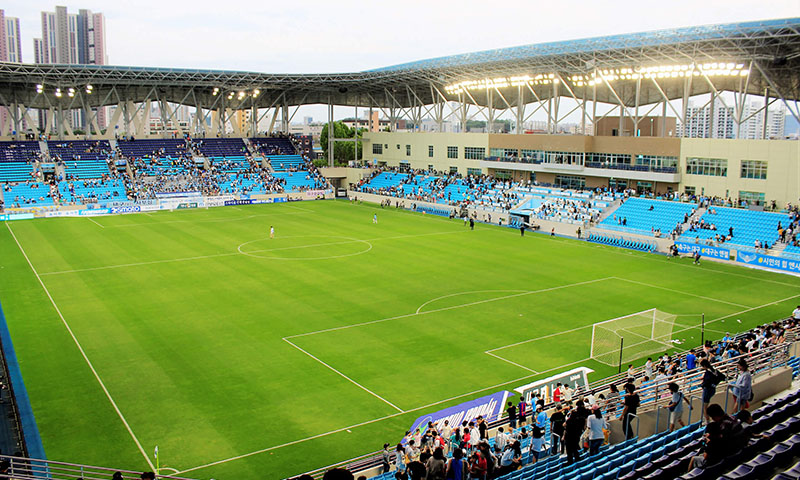
The ground is a short way from the old city wall, close enough to the river that you can smell it before you see the floodlights. DGB Daegu Bank Park is a neat, modern rectangle of a stadium, two tiers on one side and a single tier sweeping around the rest, and tonight it is perhaps a third full. The ticket cost the equivalent of about twelve pounds, and I bought it from a window where the woman stamped the paper twice and slid it back under the glass without a word.
**The club of the three titles**
Daegu FC have been champions of Korea three times in the archive years, in 2030, 2034 and last season, 2063, and twice champions of the second tier. That is a serious record for a club of this size, and it has been built on the long service of men like Jung Jae-Woo, who has made 135 league appearances over eleven seasons and scored eleven league goals. Jung is not in the side tonight, and neither is the kind of crowd that a title defence usually brings.
The club's great rivalries are with Gwangju, Pohang and Ulsan, the industrial cities to the south and east, and those are the games that fill this ground. A February Champions League night against an Australian side does not carry the same weight. The stands are dotted with families and a few blocks of younger men in sky-blue scarves, and the singing is intermittent, polite, as if everyone is waiting for the season to begin properly in the spring.
**The visitors from Melbourne**
Melbourne City are a bigger story in this competition than Daegu. They have won the Asian Champions League twice, in 2035/36 and 2036/37, and in their own league they have won the Finals Series eleven times, including five in a row between 2034/35 and 2038/39, the last title coming in 2061/62. They arrive here as a club used to these long February trips, and the bench tells you as much: Panagiotis Rigas, a regular striker, starts on the bench, and Fraser Hazell, a regular central midfielder, is not used at all. Elliot Pearson, one of the best-known players in the squad, also begins on the bench.
I ate before the game at a small place near the station, a narrow room with plastic stools and a counter that served dakgangjeong, the sweet, crisp fried chicken that Daegu does better than anywhere, with pickled radish and a cold bottle of cider. It cost a little over six pounds. The owner asked where I was from and nodded when I said I had come for the football. "Melbourne," he said. "They are strong." He said it as a fact, not a worry.
**The game**
Melbourne City are strong, and it shows from the first minutes. They have the ball, they have the corners, and Daegu, set up in a 5-2-1-2 with three centre-backs and two defensive midfielders, are content to sit narrow and wait for a break that never really comes.
The opener arrives in the sixteenth minute, a penalty converted by Juan Sthevan Cante, and from then it is a question of how many. Daegu manage two shots on target all night and hit the woodwork once, a moment that drew the loudest noise of the evening from the home end, but the second goal, from the substitute Panagiotis Rigas in the sixty-ninth minute, quietens it again. Rigas had come on in the fifty-fifth minute for Stefan, and he finished neatly from one of the many balls City worked into the box. Cameron Doherty added a third in the seventy-sixth minute, and the game was done.
Cante was the best player on the pitch, with a goal, an assist and six key passes, and the big centre-back Ezekiel Stuart made ten clearances at the other end. Daegu changed shape late, pushing into a 5-1-1-3, but it made little difference. The attendance was announced as 6,571, and by the final whistle many of them had already made their way to the exits.
**The long road east**
This is the fifteenth trip of the year, and it has been a strange route: from Salta and Montevideo to Cameroon and Togo, then north to Molde and Berlin, and now 8,371 kilometres north-east of the Olympiastadion to Daegu. The game itself barely matters in the grand scheme; Melbourne City win and move on, and Daegu are left to think about the defence of their league title, which begins in a few weeks.
I walked back towards the station after the match, past the closed shutters of the fabric shops and the bright windows of fried chicken places still doing business. The rain had stopped. A group of City fans in dark blue were singing quietly outside a convenience store, and a Daegu fan in a sky-blue scarf walked past them without looking, his hands in his pockets. It was not a bitter night. It was just a February night in a city that knows its football will matter more when the summer comes.