He was the goal, the game, the light
Joe Haigh scored a goal a game for eighteen seasons, and the numbers still do not say what he was.
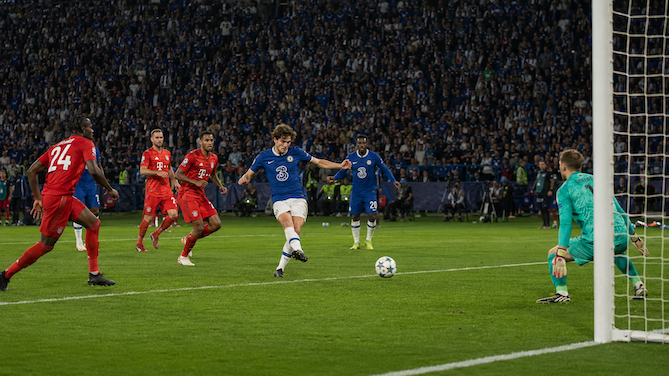
"He was the goal, the game, the light." The old Chelsea supporter said it without looking up, as if the words had been waiting for seventy years to be spoken. We were sitting in a café not far from Stamford Bridge, and the afternoon had that soft grey quality that London does so well. He was talking about Joe Haigh, and I let him talk.
For those of us who saw him, Joe Haigh was not a striker. He was a kind of weather, a force that altered the atmosphere of a match simply by being on the pitch. Eight hundred and sixty club games, eight hundred and sixty club goals. A goal a game for eighteen seasons. It is a statistic so clean, so symmetrical, that it feels like a line from a poem rather than a fact from a career. But it is true. And it is also true that it tells you nothing about the man.
The boy from the bridge
He arrived at Chelsea in the summer of 2022, a teenager with a name that sounded like a sigh and a left foot that could have been carved from something finer than bone. The European Golden Boy award came in that first season, and then the avalanche. English Footballer of the Year, Players' Player of the Year, Young Player of the Year. The Champions League Player of the Season, the Golden Boot, the Young Player award, the Forward of the Season. And then the World Golden Ball, and the World U21 Footballer of the Year. All in 2023. All before he turned twenty.
It is easy to list awards, but harder to explain what it felt like to watch him play. He was not fast in the way that sprinters are fast. He was fast in the way that ideas are fast. He would appear in a space that had not existed a second before, and the ball would be in the net, and the defenders would be looking at each other with that particular expression of men who have just been robbed by a ghost.
Twelve years of blue
For twelve seasons, from 2022 to 2034, he was Chelsea. Five hundred and forty-eight games, six hundred and forty-seven goals. The numbers are absurd, but they were real. We saw them happen. We saw the hat-tricks on frozen January nights, the goals in cup finals, the calm, almost bored way he would take a penalty in the last minute of a derby. He won everything at Chelsea, over and over. Eleven league titles, eleven FA Cups, eleven Champions Leagues. Ten Community Shields, ten UEFA Super Cups, eight Carabao Cups. Sixty-five trophies in all, by the time he was done. But it was never the trophies that mattered. It was the feeling, the certainty, that as long as Joe Haigh was on the pitch, something beautiful was still possible.
And then, in the winter of 2034, he left for Arsenal. It was not a betrayal, exactly. It was more like the end of a long marriage. Everyone understood, but nobody wanted to talk about it. He played three hundred and twelve games for Arsenal, scored two hundred and thirteen goals, and kept on winning. The goals came a little less often, but they were still goals, and they still meant something.
The long silence
He retired in 2040, at the age of thirty-five or thirty-six, and then there was a silence. Not the silence of scandal or decline, but the silence of a man who had given everything and now wanted only to be left alone. He did not become a pundit. He did not write a memoir. He did not appear on television, or at charity dinners, or in the directors' box. He simply vanished, and the game went on without him.
But the memory of him has not vanished. It is there in the way old men in cafés talk about the time they saw him score a goal that should not have been possible. It is there in the way young players are measured against a standard that no one can reach. And it is there in the numbers, those impossible numbers, that will be read and reread for as long as the game is played.
I left the café and walked down towards the river. The light was fading, and the streetlights were beginning to come on. I thought about the last time I saw him play, a cold afternoon in north London, and the way he moved across the pitch like a man walking through a dream. He scored, of course. He always scored. And for a moment, the whole stadium was silent, and then the roar came, and it was like the sound of the sea.
He was the goal, the game, the light. And now he is gone, and all we have left are the numbers, and the memory of what it felt like to watch him play.