The Night Madrid Held On
A two-goal burst, a stoppage-time reply and a penalty shoot-out made the 2032/33 UEFA Champions League final a night neither Real Madrid FC nor Chelsea could leave behind.
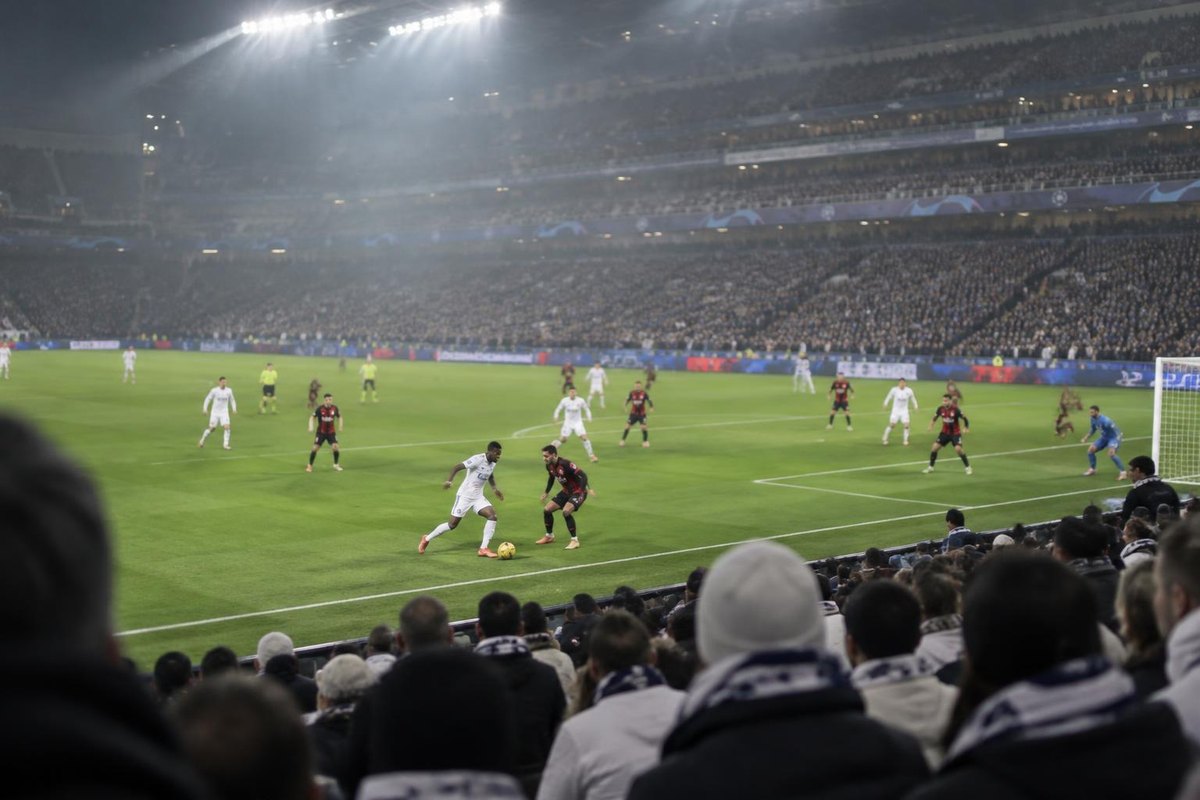
“It was not over.”
On 28 May 2033, that was the truth both clubs had to live with, first as the final slipped away from Chelsea, then as it opened again, and finally as the long ordeal of penalties asked each side to begin the ending once more. The numbers tell the sequence; they cannot quite tell how the heart keeps changing its mind.
Chelsea had arrived as the holders, having won the previous season’s final, and for a while their second straight European crown must have felt within reach. Lazăr Gaica scored for them in the 73rd minute. There is a particular weight to a goal in a final, because it seems at first to settle everything: the noise, the waiting, the anxious arithmetic of the clock. But the night was not ready to settle.
The two minutes that changed it
Eduardo Camavinga scored for Real Madrid FC in the 84th minute, then again in the 86th. Two goals, so close together that one scarcely had time to become memory before the next was upon it. In a final, the clock can be an adversary and a witness at once; those minutes gave Madrid the lead and seemed to take the cup out of Chelsea’s reach.
Then came the last turn. In the second minute of stoppage time, Gaica scored again. A final that had tilted towards Madrid was restored to a draw, and the teams went into extra time still level. There is a kind of footballing suspense that does not rise in a straight line. It pauses, offers certainty, then withdraws it. Chelsea had been ahead; Madrid had taken the lead; Chelsea had found its way back. The final had become a small history of hope being granted and taken away.
Extra time did not separate them. So the contest went to penalties, that severe little ceremony in which a season’s work narrows to one player, one attempt, and the silence before the ball is struck. The order began with Jude Soonsup-Bell, whose attempt for Chelsea did not score. Vinícius Júnior converted for Madrid. Noël de Ruiter scored for Chelsea, while Sergio Montel did not score for Madrid. Gaica, having already supplied both Chelsea goals, converted his penalty too; Aurélien Tchouameni answered for Madrid.
Mariano Lenci scored for Chelsea. Madrid’s next attempt went in, though the taker is not named here, and Mateus Itokazu did not score for Chelsea. Tim Horenburg then converted the final Madrid penalty. Four to three: the margin was a single successful kick, but the route to it had crossed the whole emotional country of the match.
A crown changes hands
There is a further sadness in the result for Chelsea, beyond the particular ache of losing a final. The old champions had held the European crown for a decade; now Madrid had it, and the final itself offered no gentle handover. Chelsea had led, fallen behind, recovered, and still been left with the empty space that follows a shoot-out defeat.
Madrid’s victory also closed a difficult chapter in the rivalry’s much longer story. In 2024, Chelsea beat Real Madrid FC 4-2 in a final remembered for changing shape before it was settled. That earlier meeting had its own drama, and its own winner. This one turned on the final minutes, on Camavinga’s quick double, on Gaica’s answer, and on the penalties that at last made a winner unavoidable.
Chelsea’s astonishing European sequence ended in 2032/33, while Real Madrid FC’s latest UEFA Champions League title, their fifteenth, came that same season. Chelsea would go on to win the competition again, and Madrid’s next triumph would not come until 2061/62; but for those watching the final itself, the future was only a darkness beyond the spot-kick, and the next attempt waiting in it.
A goal in the 73rd minute, two in the 84th and 86th, another in stoppage time; then the unsparing order of the shoot-out. Memory often softens the edges of old matches. This one keeps its sharpest edge: the ball travelling towards the goal, and the whole night waiting to learn whether it would come back out.