Remember Sol de América’s Former Home
A Copa Sudamericana night in Villa Elisa brings Club Sol de América’s past into view.
Dear editor,
The old ground is the first thing I look for, though there is no old ground to walk into. On Wednesday 19 March, I arrive in Villa Elisa for Club Sol de América’s Copa Sudamericana match against Guaireña Fútbol Club carrying a history that has outlasted the place where much of it was made. The present address is Luis Alfonso Giagni; the older one belongs to memory, and to the people who still speak of the club as something more than the ground beneath their feet.
From my last stop at Stade Olympique in Tunis, Paraguay is 9,902 kilometres south-west. That is a large distance to put between two football evenings, and not a route I can honestly compress into a neat account of trains and changes. The journey ends in the greater Asunción area, in Villa Elisa, where the city thins into the adjoining towns without quite announcing the border. Here, Sol de América is not an imported name on a fixture card. It is a club its country knows well, rooted in the everyday life of the capital’s southern edge.
I have come to see what remains of its past in the town. The answer is not a museum door or a preserved stand. It is the club itself: its name, its colours, the players supporters remember, and the way an old ground can continue to occupy space after the match has moved elsewhere. There is something quietly useful about that kind of history. It does not need to be staged for visitors.
Sol de América’s history belongs to the growth of football in Paraguay, where clubs became institutions of neighbourhood and city as much as teams. Its blue is a familiar mark in the country’s football landscape. Its move to a ground in Villa Elisa carries the club beyond the city’s old centre, but not out of the orbit of Asunción. The metropolitan sprawl is the setting, not a clean break: a club can change its address and keep the habits of its people.
### What a ground keeps
The old ground matters because it contained the club’s golden years and the days supporters still use to measure the present. I do not pretend to know the precise shape of every vanished terrace or the sound of every old crowd. The honest version is smaller: a ground is a place where people stood together, and when it is gone the stories have to travel. They travel in names.
Cristian Aguilera, Santiago Úbeda and Aníbal Agüero are among the figures Sol de América holds as legends and icons. Esteban Moreno’s name carries the weight of duration: 391 games over 14 seasons, and seven league goals. Ariel Almirón played 169 games over six seasons and scored 22 league goals. Yamil Ortigoza played 182 games over six seasons. These are not grand monuments, but the durable measures by which a club recognises service: the seasons returned to, the shirt worn again, the familiar name still present in conversation.
Damián Rodríguez, who starts against Guaireña, has played 266 games over nine seasons for Sol de América and is the club’s leading scorer in the league, with 55 goals. That makes his place in this night part of a longer account, though football is not obliged to arrange its stories tidily. He leaves the match in the 66th minute. By then he has helped put the home side ahead, and his name is already tied to a history that is being made as well as remembered.
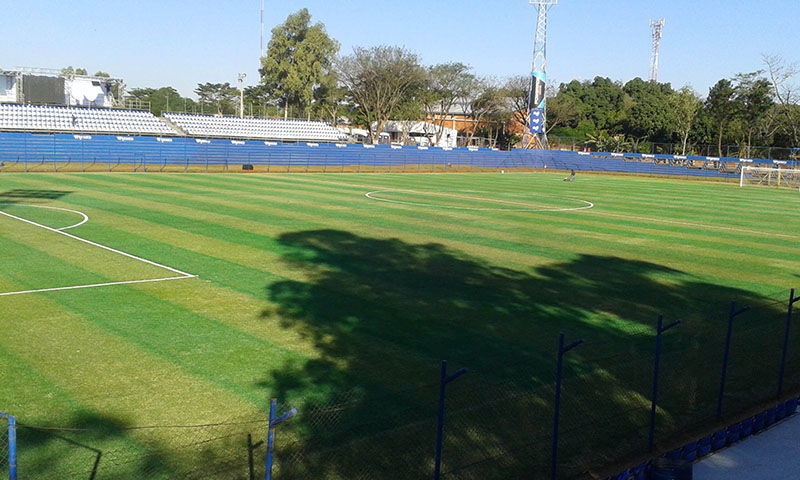
There is a particular tenderness in watching a club’s past sit alongside its present without either needing to explain the other. The supporters at Luis Alfonso Giagni do not look as if they have come to attend a lecture on old grounds. They have come to a match. Yet the club’s history is there in the names people know, in the blue around the small ground, and in the straightforward fact that Sol de América has carried on playing after leaving one home behind.
### A quiet day in Villa Elisa
Nothing goes wrong on this day. There is no missed connection to turn into a story, no locked gate, no sudden change of plan. The calm is its own kind of travel writing. I have time to notice the movement around the ground and the unceremonious way a continental fixture fits into a working town. People arrive for the football; the evening does not dress itself up for me.
The crowd is 1,050. That is enough to give the match a human scale: voices close to the pitch, the ebb and return of attention, the small pauses when everyone waits to see what comes next. Luis Alfonso Giagni is not a national monument, and the evening does not ask it to be one. Its importance is more immediate. For these supporters, it is where Sol de América is playing, and that is sufficient to make the old ground feel present by contrast.
My food table for these trips has acquired an uneven geography of its own. Daegu, Guatemala, Bristol, Estoril, Lyon and Tunis sit behind this stop, each meal belonging to a different stretch of road. In Villa Elisa I keep the ranking modest. The food does not need to defeat every earlier plate to matter; it belongs to this particular evening, in a place where the club’s past is more striking than any attempt to turn dinner into a verdict. I place it among the meals that stay with me because of where I eat them, not because I have found a universal champion.
That is perhaps the right way to approach a club’s history, too. The old ground cannot be recovered by praising it, and a list of honours would not tell me what survives in Villa Elisa. A club’s past lives partly in its archive and partly in the living routine of people going to see it play. The second part is less easy to catalogue, and more useful to witness.
### The score waits
The football takes its time to make the history feel immediate. Sol de América go ahead in the 36th minute when an unidentified home player scores from the penalty spot. Four minutes later, Damián Rodríguez scores to make it 2-0. I cannot honestly give either goal a fuller description than that. From my place in the ground, the first is a sudden change to the evening’s balance; the second leaves the home side with a clear advantage before the interval.
Guaireña do not disappear from the contest. The scoreline is 2-0 at the end, but a narrow account of the goals cannot describe every spell of pressure or every moment when the crowd turns its attention towards the other end. Sol de América take the result in this Copa Sudamericana match, with Rodríguez’s contribution adding another line to the history of a player who has already spent much of his career here.
The visitors have their own names to keep: Mario Otazú and Sebastián Esteche among the figures remembered by Guaireña supporters. There is no need to make one club’s past smaller in order to tell the other’s. This is a continental night between two Paraguayan sides, and both arrive with stories beyond the ninety minutes. But the old Sol de América ground is the thread that brings me to Villa Elisa. The result gives the evening its conclusion; it does not erase the question of what a club carries when the place that held its best years is no longer its home.
I leave with no relic from the former ground, only the sight of its successor occupied for a match and the knowledge that the names still travel. In football, a move can alter the map without ending a club’s sense of itself. The past is not standing behind the new ground like a ghost. It is in the people who have come, in the players whose service is remembered, and in the ordinary act of turning up again.
Teodor