The Boy Who Never Left Has Found Another Country
Jude Soonsup-Bell scored 386 goals in 839 games for Chelsea and never wore another club's shirt; at fifty-nine he is managing Türkiye, and the touchline suits him strangely well.
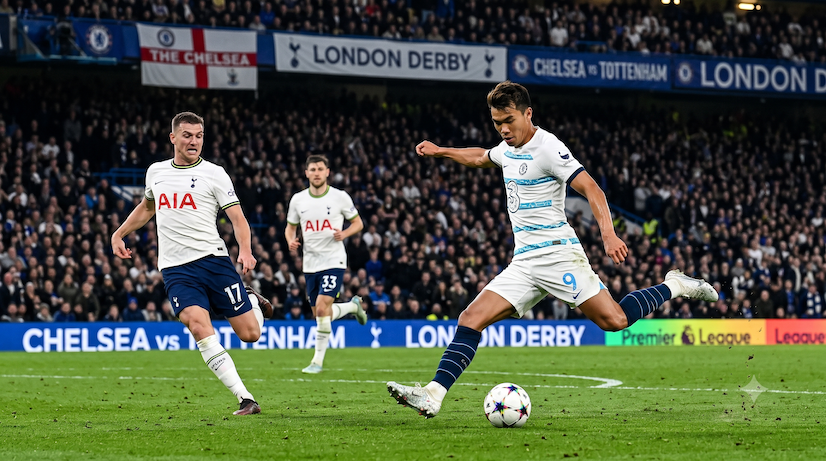
There is a photograph that has followed him for forty years, and it is not the one you would choose. Not a celebration, not a trophy lifted above a crowd, but a boy of seventeen standing on the edge of a pitch with his hands in his pockets, watching men warm up as though he had wandered in from the street. The boy is Jude Soonsup-Bell. The men are Chelsea. He would spend the next eighteen seasons among them, from 2022/23 to 2040/41, and never once wear another club's colours.
The numbers attach themselves to him like ivy: 839 games, 386 goals, 436 assists, 88 trophies, 184 caps and 137 goals for England. They were laid out again in these pages in the summer, and again in August when word came that he had taken charge of Türkiye. What the numbers cannot say is how it felt to sit in the stands and watch him play, which is the only testimony that ever mattered to the people who paid to get in.
He was not quick, exactly. He was early. He arrived at the ball before the ball had decided what it was going to do, and he did it without fuss, a midfielder who made scoring look like bookkeeping, as if the whole thing were a matter of entries and balances. There was a season — I could not tell you which, they have run together like rain on a window — when he seemed to be everywhere at once, and the crowd made a noise I have not heard since. The old ground shook. He did not.
The One-Club Man
He was a Chelsea player for the whole of it, through the twenty-three-year run as champions of Europe that ended in 2062/63, through the forty-one domestic titles that are still going, the latest won in 2062/63. He was there when the FA Cup run of three in a row ended in the same season, the club finishing runners-up. He was there for the Carabao Cup years, ten in a row, and he was long gone by the time that one closed. To be a Chelsea man in those decades was to be a man in a house where the roof never leaked. He never knew another roof. He had no need of one.
When he retired in 2041 there was a sense, among those of us who had watched him, that he would simply stay — that he would appear one morning on the coaching staff and never leave, the way the furniture of a great house never leaves. It did not happen that way. He went quiet. For a long while the only news was silence, and silence in a man of his profile is its own kind of story.
The Manager
Then, this August, Türkiye. A country with its own fierce football weather, its own demands, its own songs. He took the job at fifty-nine, and those who know him say the appointment surprised nobody who had ever shared a dressing room with him. His teams, they say, are built like his game was: quick on the flanks, narrow in the head, a 4-3-3 that asks the wide men to run until the full-backs have nothing left to think about. It is a manager's shape drawn from a player's memory.
He is not a shouter. He was never a shouter. The word that follows him now is mental — he prepares a side in the mind before he prepares it on the grass — and there is something touching in that, the great scorer grown into a teacher of the head. He was always two seconds ahead. Now he has to make other men two seconds ahead, and it is harder, and he knows it.
Across the water, Chelsea go on as Chelsea do: top of the Premier Division after eight games this cycle, a Champions League night against Liverpool to come on 24 October, and in their youth teams boys like Christian Becker and Sascha Büchel learning the trade he once knew by heart. You wonder whether he watches. You wonder whether a man who gave a single club eighteen years can bear to watch it without him. He was there for the twenty-three European years; he is not there now, and the run has ended.
At the end of the training session, the light goes long and gold over the pitch, and the players drift in. He stays, as he always stayed, a ball under one arm, watching the empty grass as though it might still do something he has not seen. Then he turns, and walks in, and the day closes behind him like a gate.